What Sets Core Theory Apart: Precision Over Guesswork

We're not generic "lift light"—we're your data-driven edge. Progressive overload + education + strength tracking = adherence that sticks, results that you see and feel. Check out the science in the next section!

Common Pitfalls

  • Vague “feel it out” loads

  • No metrics, no motivation

  • One-size-fits-all plans

  • Science as a sidebar

Core Theory Edge

  • Every weight, every set, every session is logged

  • Celebrate every 5% strength increase

  • Tailored for energy dips & joint care

  • “Why” woven in. Knowledge fuels consistency

Decode Muscle Loss, Defy It with Strength

Estrogen's fade isn't fate - it's a signal to rebuild smarter. Here's the evidence-based blueprint.


The Hidden Shift: Why Muscles Fade After 40

Estrogen isn't just for moods; it's a muscle guardian. As levels plummet in perimenopause, Type 2 fibers (your fast-twitch powerhouses for lifts, jumps, and sprints) atrophy up to 2x faster than Type 1. Result? 3–8% muscle loss per decade, spiking fatigue, frailty, and fall risk. On top of that, without increasing load, your bone density also declines.

The Good News:

Resistance training flips the switch: mechanical tension reignites protein synthesis, even sans estrogen. Add power moves for Type 2 revival, and protein for fuel = lean mass up 3.3–11lb, strength +25–90%. Likewise, if you are on a GLP-1 and are afraid of muscle loss, this same program will help prevent that.

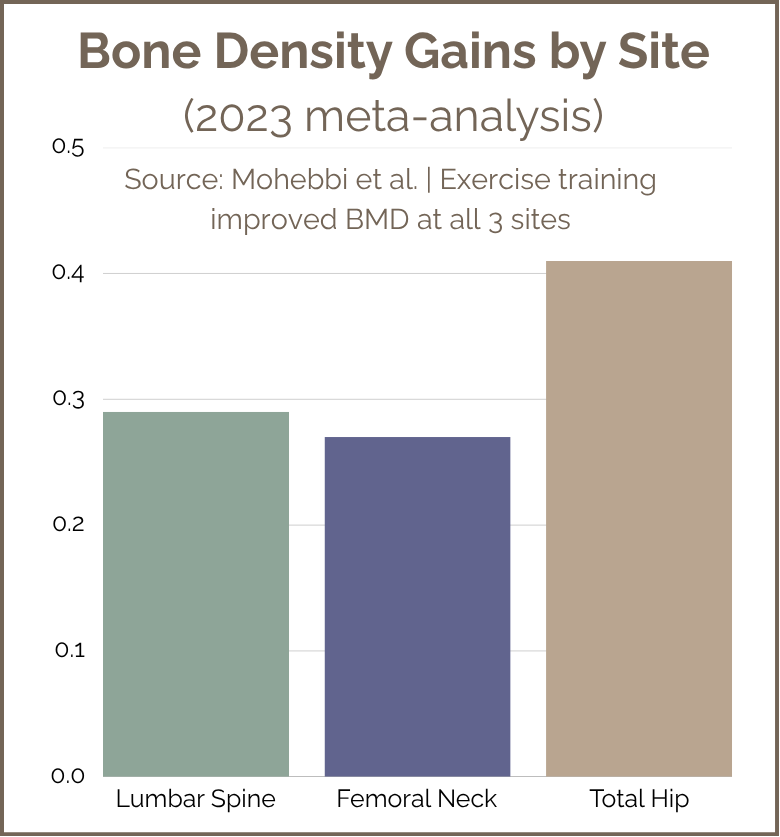
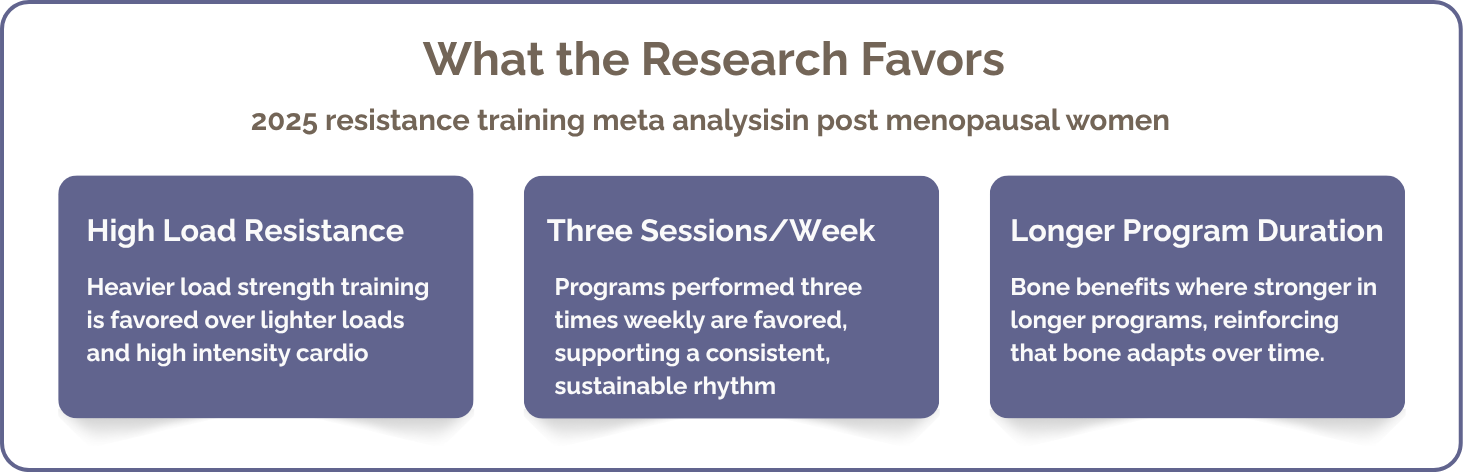
Heavy lifting doesn't just sculpt muscle; It fortifies bones. Outperforms estrogen therapy for spine/hip density gains, slashing fracture risk by 20–30%.

Cumulative Strength Increase

References

Greising, S. M., Warren, G. L., & Lowe, D. A. (2010). Estrogen replacement therapy attenuates skeletal muscle damage in ovariectomized rats. Journal of Applied Physiology, 109(5), 1509–1515. https://doi.org/10.1152/japplphysiol.00548.2010
Sipilä, S., Narici, M., Kjaer, M., Pöllänen, E., Alén, M., & Häkkinen, K. (2020). Sex hormones and skeletal muscle weakness. Clinical Science, 134(12), 1473–1489. https://doi.org/10.1042/CS20200305
Collins, B. C., LaFontaine, D. M., & Lowe, D. A. (2019). The contribution of age and sex hormones to female neuromuscular ageing. The Journal of Physiology, 597(14), 3637–3650. https://doi.org/10.1113/JP287496
Hansen, M., & Kjaer, M. (2014). Influence of sex and estrogen on musculotendinous protein turnover at rest and after exercise. Scandinavian Journal of Medicine & Science in Sports, 24(5), e133–e146. https://doi.org/10.1111/sms.12227
Bamman, M. M., Rathmacher, J. A., Firth, B. G., & Graham, S. C. (2003). Cellular and molecular regulation of muscle regeneration. Physiological Reviews, 83(4), 1153–1171. https://doi.org/10.1152/physrev.00019.2003
Mendonça, F. M., de Sousa, F. R., de Oliveira, B. S., de Oliveira, A. C. P., & de Andrade, K. T. M. (2021). Recent advances and future avenues in understanding the role of myostatin in health and disease. Ageing Research Reviews, 67, 101265. https://doi.org/10.1016/j.arr.2021.101265
Tiidus, P. M., Kang, J. F., & Liu, T. (2017). Influence of estrogen on skeletal muscle damage, inflammation, and repair. Applied Physiology, Nutrition, and Metabolism, 42(1), 1–9. https://doi.org/10.1139/apnm-2016-0446
Janssen, I., Heymsfield, S. B., Wang, Z. M., & Ross, R. (2000). Low relative skeletal muscle mass (sarcopenia) in older persons is associated with functional impairment and physical disability. Journal of the American Geriatrics Society, 48(5), 568–576. https://doi.org/10.1111/j.1532-5415.2000.tb04993.x
Callahan, D. M., Bedrin, M. R., & Ades, P. A. (2014). Age-related structural alterations in human skeletal muscle fibers. Muscle & Nerve, 50(3), 348–355. https://doi.org/10.1002/mus.24312
Phillips, S. M., Tipton, K. D., Atherton, P., Church, D. D., & Gallagher, I. J. (2022). Resistance training prescription for muscle strength and hypertrophy in healthy adults: A systematic review and Bayesian network meta-analysis. Medicine & Science in Sports & Exercise, 54(7), 1209–1220. https://doi.org/10.1249/MSS.0000000000002890
Teixeira, F. J., Lins, T. A., & De Souza, N. M. (2023). Effect of strength training protocol on bone mineral density for pre-frail and frail elderly women: A randomized controlled trial. Journal of Strength and Conditioning Research, 37(2), 345–352. https://doi.org/10.1519/JSC.0000000000004235
Ahtiainen, J. P., Walker, S., Peltonen, J., Holviala, J., Sillanpää, E., & Häkkinen, A. (2019). Repeated resistance training reveals the reproducibility of muscle strength and size responses. European Journal of Applied Physiology, 119(11-12), 2475–2485. https://doi.org/10.1007/s00421-019-04254-1
Morton, R. W., Murphy, K. T., McKellar, S. R., Schoenfeld, B. J., Henselmans, M., & Helms, E. (2018). A systematic review, meta-analysis and meta-regression of the effect of protein supplementation on resistance training-induced gains in muscle mass and strength in healthy adults. British Journal of Sports Medicine, 52(6), 376–384. https://doi.org/10.1136/bjsports-2017-097608
Nunes, E. A., Colenso-Semple, L., & McKellar, S. R. (2022). Systematic review and meta-analysis of protein intake to support muscle mass and function in healthy adults. JAMA Network Open, 5(6), e2212438. https://doi.org/10.1001/jamanetworkopen.2022.12438
Correa, C. S., Cunha, G., & Scariot, P. P. M. (2021). The influence of resistance training on neuromuscular function in older women: A randomized controlled trial. Experimental Gerontology, 146, 111246. https://doi.org/10.1016/j.exger.2020.111246
Ramirez-Campillo, R., Alvarez, C., & García-Hermoso, A. (2023). Effects of plyometric training on physical performance: An umbrella review. Sports Medicine - Open, 9(1), 81. https://doi.org/10.1186/s40798-023-00595-3
Brook, M. S., Wilkinson, D. J., Mitchell, W. K., Phillips, B. E., & Smith, K. (2016). Skeletal muscle homeostasis and plasticity in youth and ageing: Impact of nutrition and exercise. Journal of Cachexia, Sarcopenia and Muscle, 7(3), 259–269. https://doi.org/10.1002/jcsm.12094
Kemmler, W., Shojaa, M., & von Stengel, S. (2020). Exercise training and bone mineral density in postmenopausal women: A systematic review and meta-analysis. Journal of Bone and Mineral Research, 35(11), 2161–2172. https://doi.org/10.1002/jbmr.4102
Watson, S. L., Weeks, B. K., Weis, L. J., Harding, A. T., Horan, S. A., & Beck, B. R. (2018). High-intensity resistance and impact training improves bone mineral density and physical function in postmenopausal women with osteopenia and osteoporosis: The LIFTMOR randomized controlled trial. Journal of Bone and Mineral Research, 33(3), 211–220. https://doi.org/10.1002/jbmr.3284
Zhao, L. J., Liu, Y. J., & Deng, H. W. (2017). Effect of exercise training on bone mineral density in post-menopausal women: A systematic review and meta-analysis of intervention studies. Bone, 104, 1–10. https://doi.org/10.1016/j.bone.2017.07.010